Kandida Purnell, 05/04/26
Over the Easter weekend, news of a missing (and now rescued) American aircrew member dominated headlines after a US fighter jet was shot down over Iran on Good Friday. Just hours earlier, Novara Media had reported that the US was ‘hiding the true extent’ of its military casualties in the Iran war, presenting this as a problem of transparency. But these are not separate issues. They are two sides of the same phenomenon and reveal the selective visibility of war. The intense focus on an individual missing service member sits alongside the obscuring of broader patterns of injury and death, revealing how attention is directed, managed, and contained. What we are witnessing, then, is not an anomaly, but the continuation of a long-standing necropolitical logic—one I identified, analysed, and warned about years ago.
My 2018 article, Grieving, Valuing, and Viewing Differently: The Global War on Terror’s American Toll, demonstrates how the US has historically managed the visibility of its war injured and dead. Focusing on Vietnam to Global War on Terror (GWoT) era policy and practice including the ‘Dover Ban‘, my research illustrates how consecutive US Administrations (on both sides of the aisle) worked to move dead and suffering soldiers out of public view, not because they were unimportant, but because they were politically sensitive due to threatening a biopolitical facade of care and protection and ultimately threatening the ability for America to wage long-term wars.
This is the key insight: visibility is not accidental—it is governed.
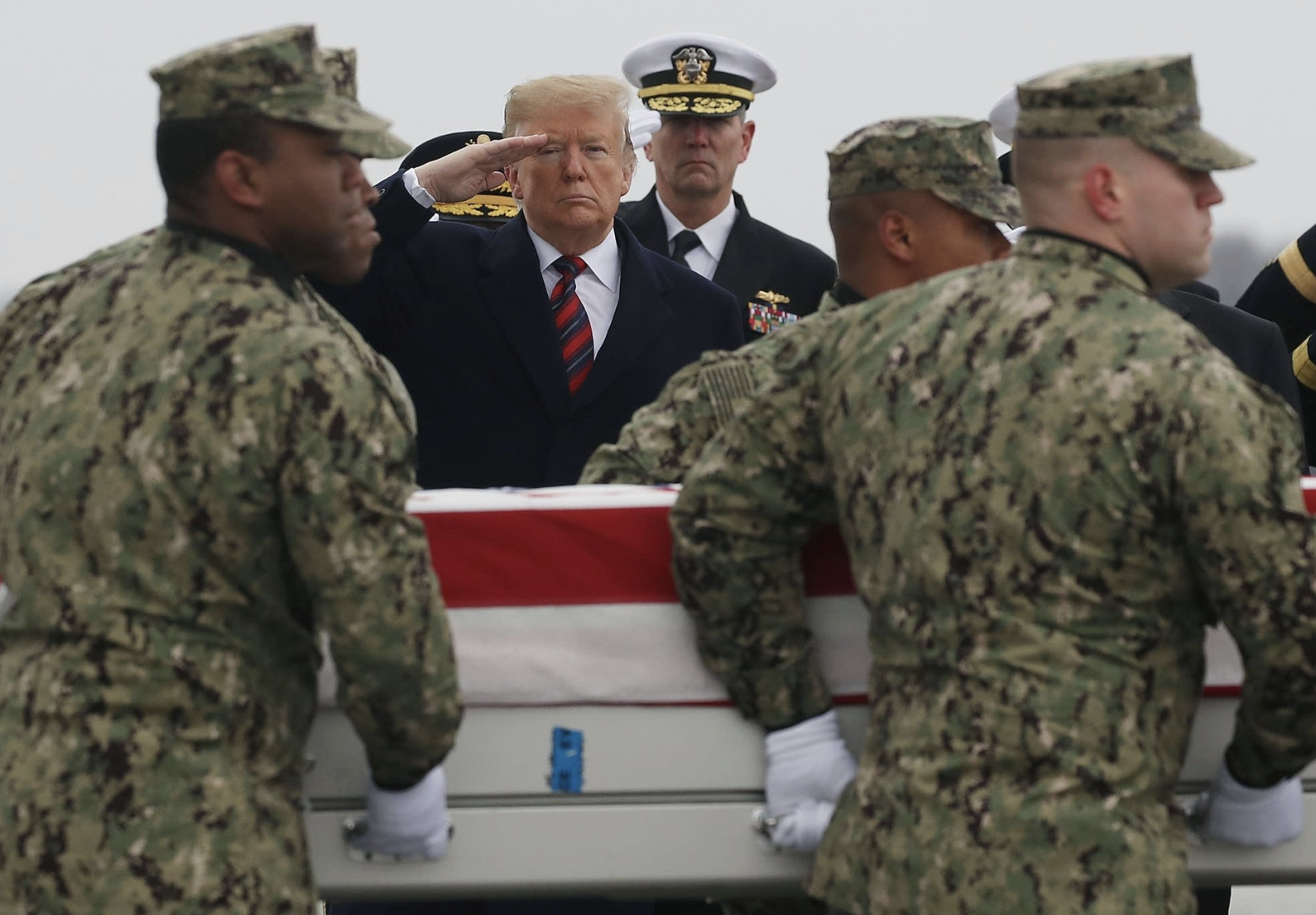
The Novara article suggests that US casualty figures are being obscured or selectively reported while on Saturday the BBC reported that the potential capture of the still then missing airman by Iran would have lead to America’s ‘profound political embarrassment’, but my work helps us understand why. As I have argued, soldiers are simultaneously treated as a ‘precious resource‘ within an intensely militarised political economy and yet rendered invisible in death, their suffering managed through practices that limit public exposure and political accountability.
What we are seeing today is not just the undercounting of casualties—it is the continuation of what I have identified as a broader system of necropolitical statecraft that regulates how death is seen, counted, and felt.
My research also highlights that the politics of counting is inseparable from the politics of valuing. The issue is not only whether deaths are recorded, but how they are framed, delayed, categorised, or excluded altogether. Moreover, and as Thomas Gregory has recently pointed out in the case of civilian casualties produced by American wars, counting becomes a technique of governance: it shapes public perception, moderates dissent, and ultimately enables the continuation of war.
This is where my continued emphasis on contested grievability becomes especially relevant. If some lives (and deaths) are made and more readily recognised as more grievable than others, then the act of counting is never neutral. It is a process of differentiation. Some deaths are made visible, others are obscured; some are mourned publicly, others are quietly absorbed into statistical ambiguity.
The Novara report sits squarely within this logic. The discrepancy between official and estimated casualty figures is not simply a data problem—it is a political one. It reflects ongoing struggles over who has the authority to count, whose counts are recognised, and what those numbers are allowed to mean.
Importantly, attention to grievability also reminds us that these processes are never uncontested. Even in the face of state efforts to suppress visibility, alternative forms of counting, witnessing, and memorialisation emerge. Families, journalists, and researchers continue to demand recognition—to insist that these lives are not reducible to managed figures or bureaucratic categories.
That tension is still present now, even as President Trump reassures Americans that although the the rescued airman ‘sustained injuries’, ‘he will be just fine‘.
So rather than asking whether the US military is hiding casualties, a more productive question is this:
What kinds of deaths are allowed to appear, and under what conditions?
Until we confront that question, debates about transparency will remain superficial. Because the issue is not simply that the numbers are wrong. It is that numbers themselves are part of the machinery through which war is made acceptable.

 Dr Kandida Purnell